Wednesday, 25 March 2020

24. Peacocks and Ermine


Above is a Peacock butterfly Aglais io, and it did not hatch this year, this hatched last year and over wintered in my green house. Peacock butterflies are easy to recognise with the big 'eyes' on the forewings, and the slightly duller eyes on the hind wings. They're also a big butterfly, 50 - 55 mm across. All the butterflies that hibernated through winter are now mating and laying eggs, then they will die.

The males are quite territorial and will hang around a good spot, maybe a garden with a dripping outdoor tap and a buddleia plant, but they especially guard nettles, they then warn off other males and mate with single female that comes for the plants or water source, then the males die. This is called monadrous mating behaviour, monadrous butterflies have short lifespan compared to butterflies that mate with several females
  
The mated female will then have to find one of only three plants to lay her eggs on, hop Humulus lupulus, small nettle Urtica urens  or stinging nettle Urtica dioca.

The eggs are tiny about 3 mm and green laid on the underside of the leaves of the host plant, they hatch out into black spikey caterpillars which can been seen in large communes hanging heavy off nettle plants.

But this is nothing compared to a caterpillars I found down a lane in Poringland last year, so dense was the silk and and the thousands of larvae that a whole tree was being consumed.
It was Ermine moth but I wasn't sure which one. These are the pictures I took and at the time (2019), I knew about this moth but had never seen it in real life.

I think this one was probably Spindle ermine moth Yponomeuta cagnagellus, mainly because the larvae were not hairy which ruled out many ermine moth species, and from what I could tell of the host tree/shrub it was possibly Spindle, it definately wasn't hawthorn or prunus. 

Not only had these moths eaten the leaves - which I was expecting - they had also eaten the petioles (stalks) and the new growth shoots the petioles were attached to.


Not something I see in Stoke Road, Poringland often, or anyone else I suspect, because lots of cars were stopping to take snaps.


UK Moths (2020) Spindle Ermine. Available at: https://www.ukmoths.org.uk/species/yponomeuta-cagnagella/ (Accessed on; 20/03/2020)

23. Tap roots and codswallop


I was out looking at some windblown trees, I didn't go out to see them, I went out to photograph adders! I often see Adders in Sisland wood, so that was my original quest, and that's the great thing about mooching about in the countryside, you may go out to with the intention of seeing a specific thing, bluebells, Jays, slow worms or muntjac...and chances are you won't see them.
But it doesn't really matter, unless your being paid to film something, after 10K of expenses and  6 weeks up a freezing mountain, then obviously not seeing a Snow Leopard would be really annoying, but for me not seeing what I want, isn't that important, because I'll see something else instead.

If you're just out for fun, looking for a thing, a specific thing, you may get lucky if you've seen it before in the same place, your chances are greatly increased if it's a stationary thing, like a plant or fungi, or something in a specific habitat like a newt in a pond, but on the down side you have to be there at the right time, or season. Making big promises to small children about the millions of bluebells they will see and then taking them to a wood 2 weeks before they flower or two weeks after, leads to a miserable drive home, and small children will punish you for this, until bribed with treats.

If your hunting a locomotive thingy then sods law predicts as soon as you announce confidently to your friend "Hey I know a place where there of lots of toads" the toads somehow know you're coming, and hide, just to embarrass you.

So going with low expectation even though you would really like to see a specific thing, is always a good plan. Finding no newts in the pond, but seeing hares boxing in a field on the way there is still pretty cool.

This day in Sisland wood was one of those days, Adders Vipera berus were laughing at me, they were in the wood, I just didn't see them, I suspect because the adders knew I had gone to the effort of buying a new camera, adders are notorious for taking the piss. Once I left the wood they gathered in a group leaning up against trees, smoking fags and saying things like "He walked right passed me, what a jerk, shoulda seen the look on his face, him and his new posh camera... Idiot."

So I just enjoyed the other things I saw, like on the way there I saw a Sparrow Hawk Accipiter nisus mobbing three buzzards Buteo buteo, and the agile hawk won the battle! I have never seen this before, I've seen three or four rooks mobbing a buzzard and also seen rooks mobbing marsh harriers Circus aeruginosus circling a rookery.

The hawk attacked the buzzards from above and behind every time, at speed, wings folded in a stoop and clipped the fanned tail feathers of the buzzards, eventually the buzzards decided enough was enough and glided up and away into the distance.


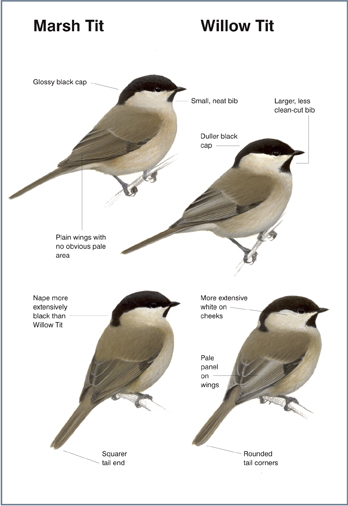
Image result for marsh tit The first thing I saw on the edge of the wood even before I had entered it, was either a marsh tit or a willow tit, I can't tell the difference, birds are not my strong suit.

Sisland is my favourite wood in Norfolk, small about 60 acres, but varied, stands of scots pine, beech, sweet chestnut, robinia and alder, and a smattering of birch, oak and a few other mixed natives.

On arriving at Sisland, the damage from Winter storms was obvious, plenty of windblown trees. Root plates folded in half. Actually more than half...when a tree is blown over often about 60% of the root plate ends up bent upward in a vertical position, the other 40% remains in situ, still in the ground trapped beneath the stem of the now horizontal tree stem. 

Seeing all these rootplates like giant half dinner plates sticking out of the ground was impressive, most 1 -2 m high, some were sticking up at 4m high. 


 At ground level the rootplate on the right of the piece sticking up is intact on the stem side, just bent at right angles and remains in place underground. The rootplate sticking up was about 2.5 m high, 1 m below the stem and 1.5 m above the stem.  


To illustrate what I'm talking about I made a highly sophisticated model from paper and a straw.


Tree upright                                                  windblown tree, notice how 40% of the rootplate is still                                                                           where it should be, the reason why some windblown trees                                                                       continue to grow on after catastrophe.. 

This rootplate was even bigger, 4 m in the air, from a poplar about 800 mm at DBH.


What I find amazing is every windblown tree I saw that day, with its rootplate up in the air not one had a 'tap root'. Because mature deciduous trees don't have tap roots. 
This is a bit of a frustrating matter for me, I was taught at school, 'all trees have a tap root' and still this myth persists, a factoid walks like a fact, talks like a fact, re-printed like a fact, but is in fact, codswallop (Rackham 2001) 

You probably know some factoids yourself, like you should feed hedgehogs in your garden with bread and milk...untrue, and it actually gives them diarrhoea. 
Or the Great Wall Of China can be seen from space...No it cannot, if you could see a wall only 5 m across you should be able to see every motorway in the world from space, which is obviously codswallop.

Now the odd thing about this is - even though you can clearly see - neither of these trees have a tap root sticking out of the middle of the rootplate, folk will still argue with me on this. Dr Claus Mattheck & Mrs Helge Breloer, Dr Oliver Rackham and Dr Alex Shigo have all written about the tap root myth, but sadly the factoid just keeps getting repeated and reprinted. I actually have 19 photos from 19 windblown deciduous trees that day and only one had a central tap root, because that tree was only about 6 years old and was brought down by a larger tree that fell on it, saplings do have tap roots.

Saplings have tap roots to stabilize them when the are young, as the tree matures these tap roots shrivel and die off or just cease to grow anymore, because their job is done. The mature tree is held up much better by a wide circular rootplate, some 60 cm deep. Why not deeper you may be thinking? Well because most of the water comes from above as rainfall and only penetrates about 60 cm into the ground. Little point in the tree wasting energy in sending down water seeking roots to bone dry ground.

Apparently the myth started a few hundred years ago when caves in Derbyshire and Cheddar were opened to the public, as people entered the caves they saw great long roots coming down into caves and terminating in pools beneath stalactites, some over 50 feet long.
No one had ever walked beneath a forest in a cave before, and it was assumed all trees did this, despite the fact the woodsmen and foresters who were very familiar with windblown trees for over 1000 years were saying 'Er, no, that's rubbish'. 

The only reason these long roots were found in caves was because there was water, caves are often damp, often have pools for the roots to touch. Totally dry caves don't have roots from trees in them. Sadly no one cared about this and botanists started making imaginary diagrams which purported to be the roots plans of trees, often these were sort of mirror images of the trees above ground, and all invented.
Below is one such fantasy diagram I found on the internet today


                                             A factoid,                     and a fact.


This factoid above was somewhat backed up by if someone pulled up a birch sapling it did indeed have a tap root, "There you go, my hypothesis is proved, hoorah", no one checked mature trees for a tap root because you can't pull a mature birch tree up!

But what amazes me still, is although woodsmen, foresters and arborists were all saying for a hundred years or so "mature deciduous trees don't have tap roots, we can prove it, check out some wind blown mature trees?" they were pretty much ignored. And even though most botanists now know the foresters were correct, many books still reprint the tap root factoid. 

This blog is aimed at adults, so I assume 'codswallop' is a word I can use?


Rackham, O. (2001) Trees & Woodland in the British Landscape. New York. Pheonix Press.

Mattheck, C., and Breloer, H. (1993) The body language of trees a handbook for failure analysis. London. HMSO.

Shigo, A. L. (1986) A new tree biology. New Hampshire. Shigo and trees, associates.


22. Marbles and Apples


Gall wasps (Cynipidae), I have to confess I love gall wasps, there are loads of them in the UK, and each one creates a different gall. Telling the gall waps apart requires quite alot of expertise, the wasps are no bigger than fruit flies and look very similar, luckily the galls that form on the trees are very different. So if you know the Gall, you know the gall wasp that created it.

        Marble gall                                                                                 Oak apple gall

So here's two I found on the same Oak tree, left is the classic marble gall, on the right is the oak apple gall, Both of these are last years galls that have clung on over winter with the occupants having left last summer of 2019.
So who was inside them, the left was a wasp called Andricus kollari, and on the right was a wasp called Biorhiza pallida, The marble galls contain 1 - 4 grubs, the apple galls contain 6 - 12 grubs.

Try not to think about Gall wasps as you might the classic vespa wasp, most gall wasps cannot sting and are tiny, 1.5 mm - 8 mm max, often a dull brown or black and pretty dull looking. 

The wasps in both cases lays there eggs in the bud of the tree and this irritates the tree which in response grow the gall, similar to a grain of sand making an oyster grow a pearl. the grubs then hatch and chew their way around the gall until ready to pupate and hatch out. 
However this is trickier than it sounds, it's all about perfect timing, The grub has strong mandibles, but the adult fly does not. The grub must anticipate when is the right time to chew a small exit hole, then pupate and crawl out through the hole as a fully developed fly. 

If it doesn't chew a hole big enough, the fly is trapped inside the gall, if it doesn't have time to chew an exit hole at all, it will pupate into a fly and is sealed inside without the mouth parts to create a hole, sad. If it chews the hole too early, this gives time for other parasitic wasps to shove an ovipositor down the hole and bury a parasitic wasp grub in the poor gall wasp's grubs skull...nature, red tooth and claw.

Experiment time
I wanted to prove what I just said was true, so I went out and came back with two marble galls, one with no exit hole at all, and the other (experience tells me) had a exit hole that was too small.
Scientific high tech tool at the ready (the Xmas nut cracker) I broke them open. results below...


The galls of Andricus kollari the marble gall wasp, which requires two different oak trees to complete its life cycle, English Oak Quercus robur or Sessile oak Quercus patraea and Quercus cerris Turkey Oak.


On the left, is a gall with an exit hole I thought was suspiciously small. 


On the right, the gall had no exit hole what so ever. 

Oh dear, as I suspected this grub was stuck inside the gall and it was dead, this is the Gall with no exit hole. 
The larvae died before it chewed its way out to the edge and cut its exit hole. remember these are last years galls, not this years, so this little larvae should have exited last September, 2019.

This was not a surprise to me, i've been opening galls since i was a kid and you nearly always fine a dead grub inside a gall with no exite hole, 

Below is something much rarer...


This is the gall with an exit hole which appeared too small, once I cracked it open I expected to see either a dead larvae, a dead pupae or a dead gall wasp.

Remember the larvae must chew an exit hole big enough to get out of once it has metamorphosed into and adult wasp, I.e. while it is still a larvae, because the adult wasp has no chewing mouthparts.

Experience told me this hole was too small, and sure enough, inside was a dead adult. meaning it create an exit hole, pupated into an adult but couldn't squeeze out of the hole. Here is the dead wasp, still inside the gall.


 This what really surprised me....it wasn't dead. 

It crawled out and sat on my finger tip. It was really skinny and would probably not survive, the abdomen, the last part behind the head and thorax should be round and fat, it should be in peak condition, most of the fat grub's (two pics above) energy should have been transfered to this wasp during pupation. But this one has been stuck inside this gall since September (8 months) the abdomen was thin and glassy transparence, poor thing. 


This is how is should have looked, stock photo.


I could go on here, with Andricus quercuscalisis the Knopper gall wasp, Diploepis rosae the robin's pin cushin gall wasp, the spangle gall wasp Neuropterus quercusbaccarum, the red currant wasp Cynips divisa, there are 360 different species of gall wasp in Europe, 4 different spangle gall wasps in the UK alone (Chinery 2016). 
On top of this there are then Sawfly which also make galls, one of which is very commonly seen on willow, plus gall making moths, aphids and leaf miners, et al. 

In fact so many galls in the UK I could have done 24 blogs on just galls. Dull but true.


Chinery, C. (2016) Britain's Plant Galls. Hampshire. Wild Guides ltd.


21. A flower... or flowers.


A short walk down my road supplied me with 20 pictures of 19 different flowers, some monoecious (bramble), some dioecious (holly), some with flowers with both male and female parts in the same flower head (nettles) , some with male and female flowers separated (oak) yet on the same plant. Some single flowers (clematis), some multiple flowers (inflorescence) Horse chestnut.


They are in fact all angiosperm plants and they all bear flowers, that's what makes an angiosperm and angiosperm...flowers!


Left is a picture I took of a female holly flower, Ilex aquifolium, male flowers would be on a separate tree. They are Dioecious plants.


The flowers of a Cherry Laurel Prunus laurocerasus, these racemes have multiple flowers (inflorescence) each on a short pedicel (stalk) from the main shoot or axis, and if enough are visited by insects each will develop into a laurel cherry. Which birds seem to like eating and then shitting on windscreen! 
They are edible for humans, but contain small amounts of hydrogen cyanide, and the pits contain much more as do the leaves. I have eaten them and to be honest you'd have to be really hungry, bland and a bit bitter.
Goose grass Galium aparine, this is the plant kids like to throw on the backs of other kids when they're not looking, as it sticks to clothing. The other name we called it as kids was 'cleavers', Throwing it in the hair of people with really long hair was also great fun (not so much fun for the person with long hair) the stems are covered in tiny hooks.
And again it has delicate pretty white flowers, hardly noticeable as the plant is the ground covering kind more than upright. It is called a weed, not a flower, but the picture does not lie, it does indeed have flowers.
Quercus robur the English oak tree or pendunculate oak, also bearing flowers. This isn't my best picture, but at the base of my index and middle finger is a small triangular shadow, just to right is what appears to be a small green catkin, this is the male flower of the oak tree, the female flower is tiny pinkish and in the axils of the new leaves, and the females turn into the acorns. 
This is called a monoecious plant (of one house) meaning male and female sexual parts are on the same plants, Dioecious (of two houses) is when male parts are on one plant and female on a another (Like Holly)

Ash trees seem to not follow the rules biologist have set them, can be wholly male, female, mixed, 90% male with a female branch, or alternate between all choices season to season, go figure. 

Sloe Prunus spinosa most importantly the source of the flavouring  Sloe gin, difficult to identify from many of the other cherries, bullaces, damsons and plums. Easy to identify in fruit though, if you eat another other plum like fruit it may be sweet or if under-ripe a bit sour. Sloes are unforgettable as the sourest thing you have every put in your mouth ever. 
So if it taste a bit sour it's a bullace, or wild plum, if your face feels like it's about to turn inside out...it's a sloe.


Blossom out before leaves
Hawthorn Crataegus monogyna, not quite opened up but will flower in a huge white spray of blossom in the next few days.


Leaves out before blossom.
Field maple Acer campestre with its terminal flowers just beginning to open, not an impressive flower, but a flower none-the-less. Green/yellow almost exactly the same colour as the new leaves, very small, inconspicuous and most people never notice these flowers, and each one that gets fertilized (unless eaten by birds) will grow into the familiar double samara fruit (helicopter)
Red dead nettle Lamium purpureum.
This looks just like henbit dead-nettle L. amplexicaule, but henbit doesn't have stalks (petioles) on the leaves from the square stem. red dead-nettle does have petioles.
It also has - rather than radial symmetry in the flowers - it has zygomorphic symmetry, only symmetrical in one plane, it is a mirror image either side of that single, bilateral line
Ground ivy Glechoma hedercea another member of the dead nettle family (Laminaceae) along with mint, basil Marjoram and sage. and many of the other herbs we use.
White dead nettle Lamium album. The name dead nettle refers to the inability to sting, once a real stinging nettle Urtica dioica has been pulled up dry for a day it cannot sting, the little sacs of poison on the stinging hair just shrivel up on a real dead nettle.

This dead-nettle is not related to actual stinging nettles very closely at all, other than in its appearance.
Just as Prince Harry and James Hewitt (Princess Diana's close friend) may look very similar, they are in fact completely unrelated. I wonder if anyone actually reads this?
Bramble Rubus fructicosus In this picture the flowers are just about to erupts from a closed protective calyx of a very pale whitish green, and each one - in turn - if fertilized becomes a blackberry. The flowers will be whitish/green when it unfolds
Forget-me not Myosotis arvenis 
I have little so say about these apart from they are charming, forming ground cover in a wood land clearing.
A sea of forget-me-nots 
Wild cherry Prunus avium. Does have small edible cherries, but they are not always seen...birds can eat the fruit before it is ripe enough for humans, so quite often the trees are stripped of fruit before they get a chance to become red and noticable. 
Horse chestnut Aesculus hippocastanum this is a classic flower on a tree that people do notice. upright racemes of white candlestick of bloom. If the flowers are indigo in colour - as a few street trees are - then it's not the common horse chestnut, it will be an naturalised introduced species the Indian Horse Chestnut Aesculus indica
Lunaria annua Honesty. This is a flower in the wild but not a 'wild flower' it's an escapee from gardens. Which why I wasted hours trying to identify it in wildflower ident' books. Only for someone to later tell my its what gardeners call a proper flower, not a weed or a wildflower. How was I to know?
Cow parsley Anthriscus sylvestris is edible, but why you would eat it beats me, I have tried it and it tastes like nasty very bitter carrot. The other reason I wouldn't eat it... is its so similar the hemlock Conium maculatum (which is poisonous) why risk eating a foul tasting plant that looks just like a very poisonous plant?

Poor old humble Cow parsley has developed something of a bad rep', not in europe where it is native and very common. But in the USA where it has made it onto several wanted posters different states, as an invasive species, other british plants on the list is what the Americans call 'English Ivy' or our regular plain old ivy Hedera helix


A Clematis escaping oversomeone's wall. I don't know which this is and to be honest having spent hours pointlessly looking for 'honesty' in a wildflower book, I was damned if I was going to waste hours on this sneaky harlot in various gardening books.
this is Clematis sp, a possibility of 300 species and further crosses or cultivars. closely related to buttercups and anenomies. 
Wild angelica Angelica sylvestris 
Part of the carrot family, wildely used in folk medicine and as a cooking ingredient.

Purple leaved plum Prunus cerasifera in blossom, notice how complex the flowers are compared to simple wild cherry. This will also bear fruit, but can be a little sour, sweeter than sloes (everything is sweeter than sloes, bah) but not as sweet as commercial cultivars.

The Prunus genus is a strange group in that we have been crossing them for hundreds of years making cultivars and hybrids, we tend to class them by fruit size and shape, Nectarines, peaches, almonds, plums, cherries, damsons, greengage, bullaces and sloes are all Prunus sp. They also hybridize in the wild which can lead to nailing a species being rather difficult.


Mitchell, A (1999) Trees Of Britain and Northern Europe. London. Collins